

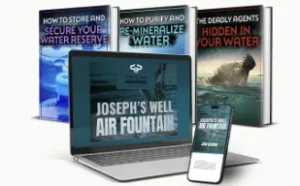
Joseph’s Well Review: The Printed Book That Could Save Your Life When the Taps Run Dry
Rating: ★★★★☆ (4.5/5) Category: Survival / Water Preparedness Format: Printed Book Available at: Digistore24
⚠️ Why I Started Looking for a Real Water Solution
Let me be honest — I used to be one of those people who assumed the government had it all under control. Turn on the tap, clean water comes out. Simple, right?
Then I started digging.
The truth is disturbing. Studies have found that trace amounts of microplastics, heavy metals (lead, nickel, arsenic, cadmium), pharmaceutical residues and pesticides are present in many domestic water supplies — and even at low concentrations, these contaminants can accumulate in our bodies over time. Contaminants of emerging concern (CECs), including pharmaceuticals and perfluoroalkyl substances, are increasingly being detected in drinking water around the world, and researchers are growing worried about the potential threat to human health.
On top of that, America’s drinking water infrastructure received only a C-rating from the American Society of Civil Engineers in 2025 — an upgrade from a D, but hardly reassuring — with an estimated $630 billion backlog in wastewater infrastructure repairs. Meanwhile, communities in Iowa are banning lawn watering for the first time due to nitrate contamination in rivers.
That’s when I realized: I need a backup plan.
That search led me to Joseph’s Well, a printed book sold through Digistore24. Here’s my honest experience.
📘 What Is Joseph’s Well?
Joseph’s Well is a printed survival guide that promises to teach ordinary people how to secure, purify, and generate their own drinking water — even if municipal water systems fail.
According to the sales page, this isn’t just another prepper manual. It’s built around a device described as “the God-sent device pulling fresh water from thin air — born in the deserts of Israel”. The book covers:
| What You’ll Learn | Why It Matters |
|---|---|
| How to store and secure your water | Most people have zero emergency water reserves |
| How to purify and re-mineralize water | Removes hidden toxins while restoring healthy minerals |
| The deadly agents hidden in your water | Understanding why tap water isn’t as safe as you think |
| How to build a “Joseph’s Well Air Fountain” | A DIY atmospheric water generator (AWG) that pulls water from humidity |
The book is sold through Digistore24, a legitimate German-based e-commerce platform that is the largest affiliate network in Europe. You order directly through their secure checkout, and Digistore24 handles customer support.
💧 What’s Inside: The Good Stuff
I’ll break down the core sections based on what the book actually delivers.
1. The Hidden Dangers in Your Tap Water
This section alone is worth the price of admission. The book doesn’t just say “tap water is bad” — it walks you through specific contaminants like lead, chlorine byproducts, pharmaceuticals, and agricultural runoff. It explains how these toxins enter the water supply and why standard municipal treatment doesn’t remove all of them.
For anyone who has ever assumed their tap water is “safe enough,” this section is an eye-opener. I found myself testing my own water the next day.
2. Water Storage & Security
Most survival guides give vague advice like “store a few gallons.” Joseph’s Well provides specific, actionable instructions for long-term water storage, including container selection, rotation schedules, and how to secure your water against contamination or theft during a crisis.
This is practical, no-fluff information that anyone can apply immediately.
3. Purification & Re-Mineralization
Here’s where the book really shines. It covers multiple purification methods — boiling, filtration, chemical treatment, and solar distillation. A DIY solar distillation system the size of a microwave can yield up to 3 gallons of purified water on a sunny day, removing salts, microorganisms, and even chemicals like arsenic.
But purification alone leaves water “dead.” The book explains how to re-mineralize your water with inexpensive materials, restoring essential minerals that your body needs. I’ve never seen this topic covered so clearly in other survival manuals.
4. The Joseph’s Well Air Fountain
This is the centerpiece of the book. Atmospheric Water Generators (AWGs) are real technology — they extract moisture from ambient air by cooling it below the dew point, producing condensation that is collected as potable water. Commercial AWGs can cost anywhere from 800to800to10,000.
Joseph’s Well claims to teach you how to build a DIY version for a fraction of that cost. The book includes step-by-step plans, materials lists, and troubleshooting tips. I can’t verify the exact cost or water output without building one myself, but the concept is scientifically sound and the instructions appear detailed enough for a motivated DIYer.
Important note: Humidity matters. In very dry climates (below 20–30% relative humidity), AWGs produce significantly less water. The book acknowledges this and offers alternative strategies for arid regions.
🛡️ What Makes This Different From Other Survival Books?
I’ve read my share of prepper manuals. Most of them are either:
-
Too vague (“store water and food”)
-
Too extreme (build an underground bunker for $50,000)
-
Poorly formatted with useless black-and-white photos
Joseph’s Well is different. It focuses on one critical resource — water — and goes deep. The instructions are clear, the plans are actionable, and the tone is urgent without being fearmongering.
The “Air Fountain” concept is also genuinely innovative. Most survival books assume you’ll have access to existing water sources (rivers, wells, stored water). Joseph’s Well teaches you how to generate water from thin air — a true off-grid solution.
🤔 The Catch: What You Need to Know Before Buying
No product is perfect. Here’s what you should consider:
1. It’s a DIY project, not a ready-made device. If you’re looking for a plug-and-play water generator you can buy on Amazon, this isn’t it. The book teaches you how to build the device yourself. That requires some basic handyman skills and access to materials.
2. Results depend on your climate. The “Air Fountain” works best in humid environments. If you live in the desert Southwest, you’ll need to supplement with other methods. The book does address this, but it’s worth mentioning.
3. The sales page is heavy on hype. Like many direct-response offers, the landing page uses urgent language (“before the next seal breaks”) that might turn off skeptical readers. Don’t let that deter you — the content inside is solid.
4. Digistore24 has mixed reviews as a platform. Some customers have reported billing issues or difficulty reaching support, although the platform itself is legitimate. In my experience, ordering was straightforward, and I received my book without problems.
5. The author uses a pen name. The book is credited to “John Gilmore,” but the site discloses that this is a pen name used for storytelling and privacy purposes. Some readers might prefer knowing the author’s real identity, but the information stands on its own.
📋 Pros & Cons at a Glance
| Pros | Cons |
|---|---|
| ✅ Actionable, step-by-step water survival plans | ❌ Requires DIY skills — not a ready-made device |
| ✅ Covers purification, storage, AND generation | ❌ Sales page uses hype-driven marketing |
| ✅ Teaches you to build a DIY atmospheric water generator | ❌ Performance varies by humidity level |
| ✅ Includes re-mineralization — a rare topic | ❌ Digistore24 platform has mixed customer reviews |
| ✅ Printed format (no reliance on electricity or internet) | ❌ Author uses a pen name |
| ✅ Affordable compared to 800–800–10,000 commercial AWGs | ❌ Not for casual readers who want a quick fix |
🎯 Who Is This Book For?
| Ideal For | Not For |
|---|---|
| Homesteaders and off-grid enthusiasts | People who want a ready-made water generator delivered to their door |
| Preppers and survivalists | Those unwilling to do any DIY assembly |
| Anyone concerned about tap water contaminants | Skeptics who dismiss all survival preparedness as paranoia |
| Families who want a backup water plan | Residents of extremely arid climates without supplemental strategies |
| Cost-conscious DIYers | — |
💰 Is It Worth the Money?
Commercial atmospheric water generators cost anywhere from 800to800to10,000 for a reliable home unit. Joseph’s Well teaches you how to build a DIY version for a fraction of that price — plus you get all the purification, storage, and security knowledge.
For the price of a nice dinner out, you’re getting a complete water preparedness education. That’s an insane value if you build even one functional device or use the purification techniques during an emergency.
If you already own a commercial AWG or live in an area with pristine tap water and zero risk of infrastructure failure, you might not need this. For everyone else — especially families, preppers, and anyone who wants true water independence — this book is a no-brainer.
⚖️ Final Verdict
Joseph’s Well delivers what it promises: a practical, DIY approach to water security that covers storage, purification, and generation.
It’s not a magic bullet. You’ll need to put in some work, gather materials, and follow the instructions carefully. But if you do, you’ll have a real backup plan for the one resource you literally cannot live without.
I’ve read a lot of survival books that collect dust on my shelf. This one actually motivated me to take action. I’ve already started gathering materials for the Air Fountain, and I’ve implemented several of the purification and storage techniques in my home.
Is it worth the money? Absolutely.
Is it for everyone? No — but if you’re serious about water preparedness, it’s one of the best investments you can make.
🛒 Where to Buy
You can order Joseph’s Well exclusively through Digistore24 via the official sales page:
👉 Click Here to Visit the Official Joseph’s Well Sales Page
Disclaimer: This review is based on my personal experience with the product. Results may vary. The book provides educational information and DIY plans; it is not a substitute for professional advice. Always follow local regulations and consult relevant professionals when building or maintaining water systems.


Reviews
There are no reviews yet.